
What Is Leverage in Forex? A Realistic Guide for Beginners
October 31, 2026

Leverage is the reason a trader with $500 can control a $50,000 position. It is also the reason most beginners lose money faster than they expected to. Both statements are true, and the difference between them comes down to one thing: whether you understand that leverage is a borrowing facility, not a strategy.
This lesson covers what leverage actually does, the critical distinction between available leverage and used leverage, and why the number your broker advertises matters far less than most traders assume.
What leverage actually means
Leverage lets you control a position larger than your account balance, using borrowed capital from your broker. It is expressed as a ratio.
Leverage 1:100
Your capital: $1,000
Position you can
control: $100,000
Broker provides: $99,000
Without leverage, buying one standard lot of EUR/USD would require $100,000 in your account. Almost no retail trader has that. Leverage makes the market accessible to people with ordinary amounts of capital — which is genuinely valuable, and why it exists.
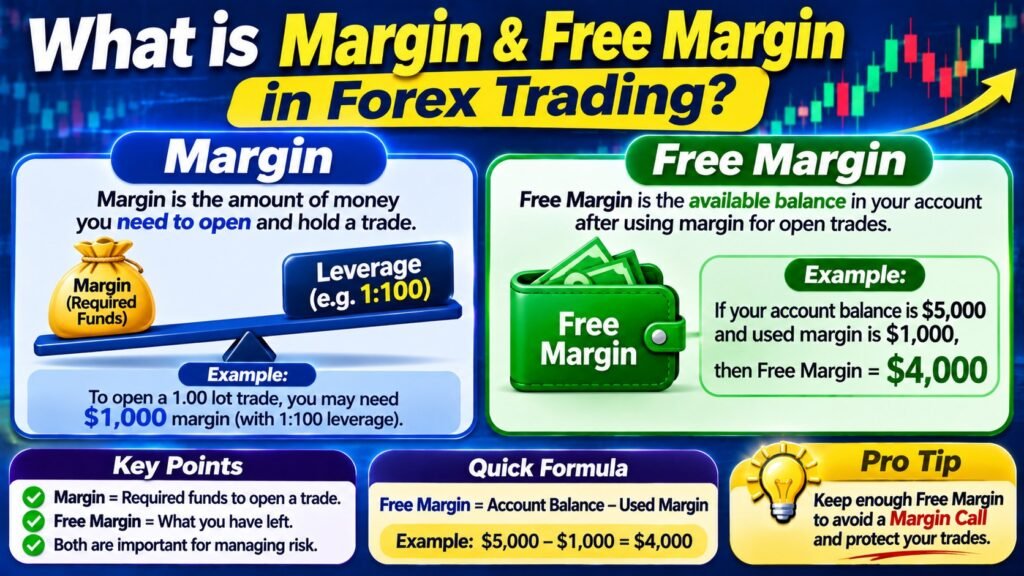
The borrowed portion is not a loan in the conventional sense. There is no interest schedule or repayment plan. The broker simply requires you to hold a deposit — called margin — as collateral while the position is open. We cover margin fully in Lesson 8.
The distinction that matters most
Here is where nearly all confusion around leverage originates.
Available leverage is the maximum your broker permits — 1:100, 1:500, whatever appears in your account settings. Used leverage is how much you actually deploy, determined entirely by your position size.
These are completely different things, and only the second one affects your risk.
Account: $1,000
Available: 1:500
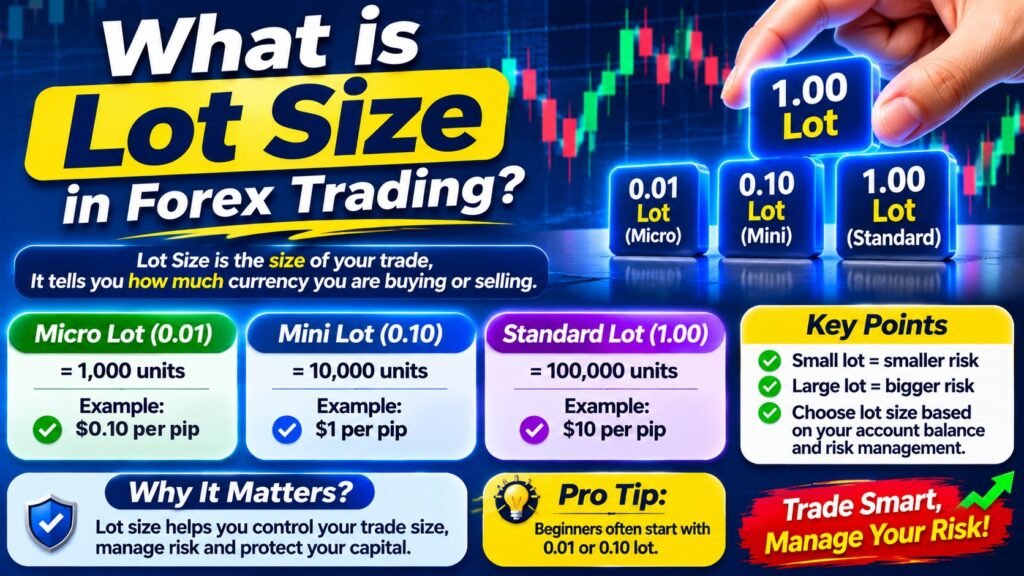
Trade A — 0.01 lots ($1,000 position)
Used leverage: 1:1
Trade B — 0.50 lots ($50,000 position)
Used leverage: 1:50
Both traders have 1:500 available. One is using essentially none of it. The other is using a tenth of what is available and is already in dangerous territory for a $1,000 account.
This is why the question “is 1:500 leverage dangerous?” has no useful answer. High available leverage is only dangerous in the hands of someone who uses it. In itself, it is an unused facility sitting in your account settings.
The reframe that helps most
Stop thinking of leverage as something you choose and start thinking of it as something that results from your position size. You never decide “I will use 1:50 leverage today.” You decide a lot size — and the leverage figure is simply the arithmetic consequence. Get the position size right and leverage takes care of itself.
How leverage amplifies outcomes
Leverage multiplies both directions equally and without preference. This is worth seeing in numbers.
Assume a $1,000 account and a 50 pip move on EUR/USD.
| Position | Used leverage | 50 pips gain | 50 pips loss |
|---|---|---|---|
| 0.01 lots | 1:1 | +$5 (0.5%) | −$5 (0.5%) |
| 0.05 lots | 1:5 | +$25 (2.5%) | −$25 (2.5%) |
| 0.20 lots | 1:20 | +$100 (10%) | −$100 (10%) |
| 1.00 lots | 1:100 | +$500 (50%) | −$500 (50%) |
Look at the bottom row. A single 50 pip move — which EUR/USD can produce in an hour on an ordinary Tuesday — either grows the account by half or destroys half of it.
Most beginners look at that row and see the left column. Experienced traders look at the same row and see the right column. That difference in attention is, more than any technical skill, what separates the two groups.
Why losses are harder to recover than they look
There is an asymmetry in percentage losses that is not intuitive and deserves its own section.
| Account loss | Gain needed to recover |
|---|---|
| 10% | 11% |
| 25% | 33% |
| 50% | 100% |
| 75% | 300% |
| 90% | 900% |
Lose 50% and you need to double what remains just to return to where you started. Lose 90% and you need a tenfold gain — which, realistically, is not happening.
This table is the entire argument for conservative leverage stated in mathematics rather than opinion. Small losses are recoverable through ordinary trading. Large losses require extraordinary performance, and traders reaching for extraordinary performance take larger risks, which produces larger losses. It compounds in the wrong direction.
What leverage should you actually use?
The honest answer is that you should not be choosing a leverage number at all. You should be choosing a risk percentage and letting position size follow, exactly as we covered in Lesson 5.
But if you want a practical reference point for what used leverage looks like at sensible risk levels:
A trader risking 1% per trade with a 40 pip stop is typically using somewhere between 1:2 and 1:10 effective leverage. That is dramatically below what most brokers offer, and it is what disciplined trading actually looks like in practice.
Traders consistently operating above 1:20 used leverage are, in my experience, either very experienced with a documented edge, or on a short path to a significant loss. There is not much in between.
On broker leverage settings
Some brokers let you choose your account leverage. A reasonable approach: select something moderate like 1:100. It provides ample capacity for properly sized positions while making it physically impossible to open a position large enough to destroy the account in one trade.
If your broker only offers 1:500, that is not a problem in itself — it simply means the discipline has to come from you rather than from an account setting.
Regional differences
Leverage limits vary significantly by jurisdiction, because regulators reached different conclusions about retail protection.
The European Union and United Kingdom cap retail leverage at 1:30 on major pairs. Australia applies a similar limit. The United States caps at 1:50. Many offshore jurisdictions permit 1:500 or higher.
It is worth understanding why those caps exist. European regulators reviewed broker data and found the large majority of retail accounts losing money, with high leverage strongly associated with faster losses. The caps were a response to evidence, not an arbitrary restriction.
That does not mean offshore brokers are unsuitable — many are well run and properly regulated in their own jurisdictions. But if you are trading at 1:500 while regulators elsewhere concluded 1:30 was the safe limit for retail traders, that is worth sitting with honestly.
Where I see this go wrong
The most common sequence I have watched: a trader opens a small account with high leverage, wins the first few trades because position size felt exciting rather than calculated, concludes they have found something, increases size further — and then meets an ordinary losing streak that any strategy produces. The early wins were the problem, not the losses. They taught the wrong lesson at the worst possible moment.
What to do next
You now understand leverage as a mechanism rather than a feature — and more importantly, that used leverage is a consequence of position sizing rather than an independent decision.
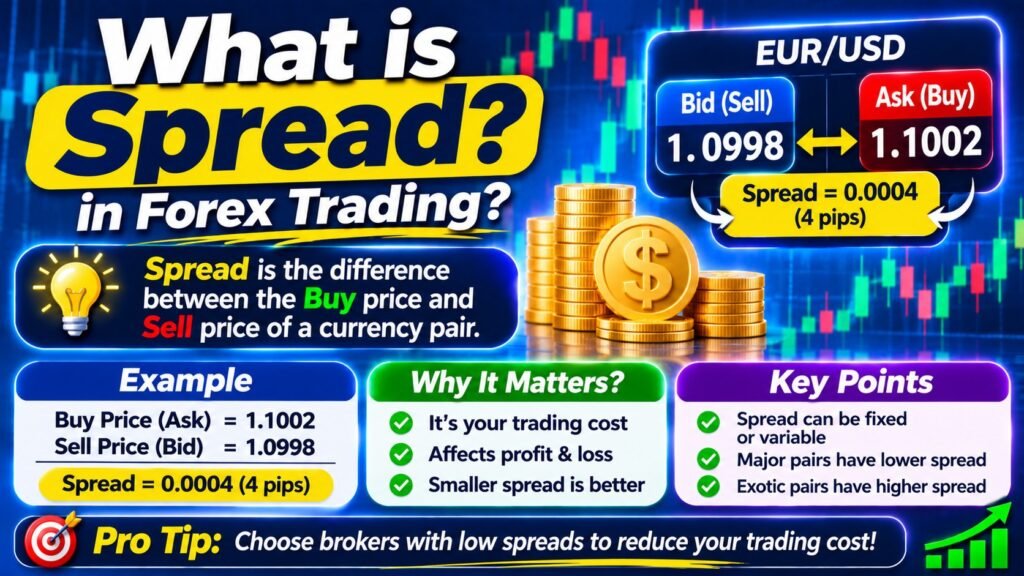
Lesson 7 covers spread, the cost built into every trade you place. It is smaller than leverage in impact but adds up significantly over hundreds of trades, particularly for anyone trading actively.
Frequently asked questions
What leverage is best for beginners?
The question is better framed around position size. If you risk 1% per trade with a sensible stop, your effective leverage lands somewhere between 1:2 and 1:10 regardless of what your account is set to. If you must pick an account setting, 1:100 gives enough capacity for correctly sized positions without allowing account-destroying trades.
Can I lose more than my deposit with leverage?
Most regulated brokers now offer negative balance protection, meaning you cannot lose more than you deposited. Check that this applies to your account specifically. Without it, a severe gap — such as a weekend news event — could in theory leave you owing the broker money.
Does higher leverage mean higher risk?
Not directly. Higher available leverage means higher possible risk, but the risk only materialises if you use it. A trader with 1:500 available who opens 0.01 lots is taking almost no risk. Risk comes from position size, and leverage is what permits that size.
Why do regulators cap leverage at 1:30 in Europe?
European regulators reviewed broker data showing most retail accounts lose money, and found high leverage strongly associated with faster and larger losses. The 1:30 cap on major pairs was introduced as a consumer protection measure based on that evidence.
How do I calculate the leverage I am actually using?
Divide your total open position value by your account equity. A $10,000 position on a $1,000 account is 1:10 used leverage. Most platforms display this, and our Margin calculator shows the collateral required for any position size you are considering.
Should I change my broker leverage setting?
If your broker allows it and you find yourself tempted to open oversized positions, lowering the account leverage is a legitimate self-control mechanism. It removes the option rather than relying on willpower at the moment of entry. Several traders I know do exactly this deliberately.