
What Is Spread in Forex Trading? Costs Explained
October 31, 2026
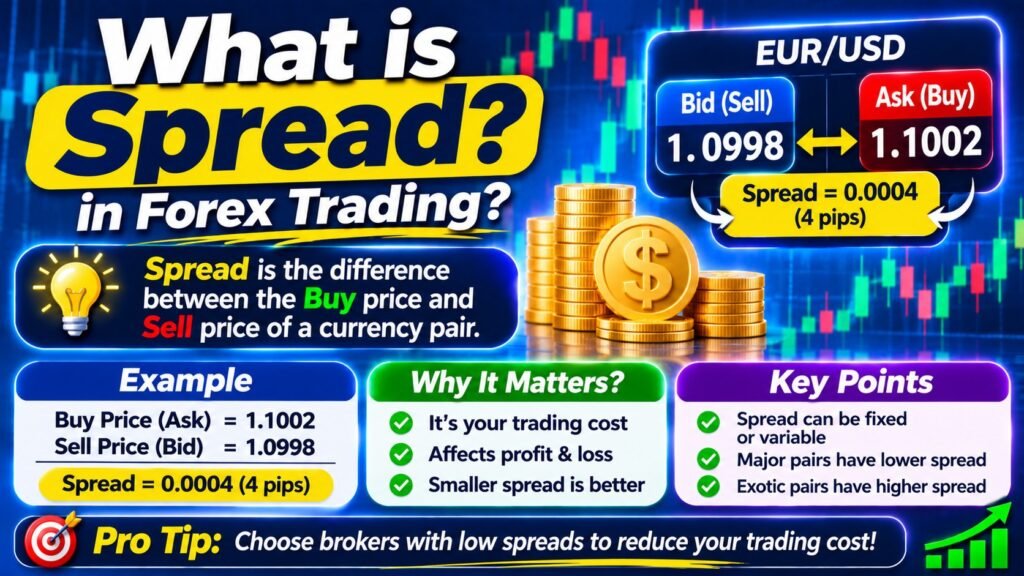
Every trade you open begins at a small loss. Not because you made a mistake, but because buying and selling happen at two different prices. That gap is the spread, and for anyone trading frequently it is the largest recurring cost in their business.
This lesson covers how spread works, why it changes throughout the day, and how to judge whether the spread you are paying is reasonable or quietly damaging your results.
Two prices, always
Your platform never shows one price for a currency pair. It shows two.
EUR/USD
Bid (you sell here): 1.08500
Ask (you buy here): 1.08512
Spread: 1.2 pips
The bid is what a buyer in the market is willing to pay — so it is the price you receive when selling. The ask is what a seller is asking — so it is the price you pay when buying.
The ask is always higher than the bid. The difference between them is the spread, and it goes to your broker and the liquidity providers behind them.
Why this means you start negative
Buy EUR/USD at the ask of 1.08512, and your position is immediately valued at the bid of 1.08500 — because that is where you would have to sell to close it.
You are down 1.2 pips before the market has moved at all. Price must rise 1.2 pips just to bring you to breakeven.
On a single trade with a 40 pip target, that is a 3% tax on the outcome. Trivial. Over four hundred trades a year, it is the difference between a profitable year and a flat one.
Fixed versus variable spreads
Variable spreads change with market conditions. They tighten when liquidity is deep and widen when it thins. Most ECN and STP brokers offer these, and on major pairs during active hours they are usually the cheaper option.
Fixed spreads stay constant regardless of conditions. They are typically wider than the average variable spread, but predictable — you know your cost in advance.
The important detail with fixed spreads: they are fixed under normal conditions. During extreme volatility, most brokers reserve the right to widen them anyway, which is usually buried in the terms. Fixed does not mean guaranteed in all circumstances.
For most traders, variable spreads on major pairs work out cheaper. The exception is anyone trading through news events, where predictability has real value.
Why spreads widen
Spread is a direct expression of liquidity — how many participants are actively quoting prices. When many institutions compete to quote, the gap narrows. When few do, it widens.
Four situations reliably widen spreads:
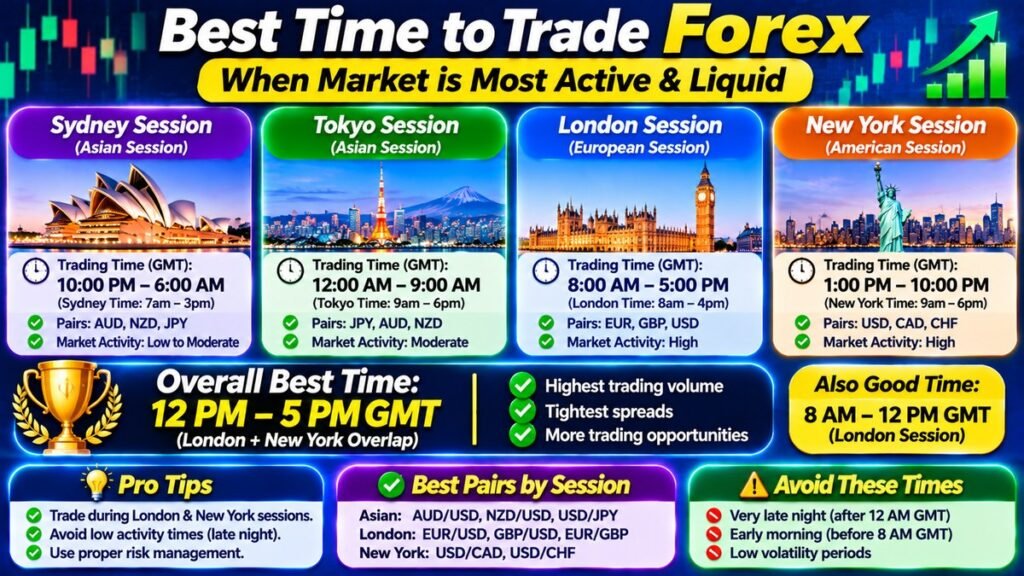
Low-liquidity hours. During the late Sydney session, when London and New York are closed, far fewer participants are active. Spreads on EUR/USD that sit at 0.3 pips during the London–New York overlap can reach 2 pips or more at 03:00 GMT.
Immediately before and during major news. Liquidity providers widen quotes ahead of releases like Non-Farm Payrolls or rate decisions, because they do not want to be caught on the wrong side of a violent move. This can be dramatic — spreads multiplying five or tenfold for a few seconds.
Market open on Sunday. The first minutes of the trading week have thin liquidity and frequently wide spreads, sometimes alongside a price gap from Friday’s close.
Holidays and low-volume periods. Major public holidays in financial centres, and the last two weeks of December, consistently produce wider spreads and thinner conditions.
A costly beginner mistake
Traders sometimes set a tight stop loss and get taken out during a spread widening — not because price actually reached their level, but because the widened spread touched it. Placing tight stops just before a major news release is a genuinely avoidable way to lose money. Either widen the stop, reduce size, or stay out of the release entirely.
What a reasonable spread looks like
Judging whether your broker’s spread is fair requires knowing the typical range. These are figures you can expect from competitive brokers during active hours:
| Instrument | Competitive | Acceptable | Expensive |
|---|---|---|---|
| EUR/USD | 0.0 – 0.6 | 0.7 – 1.2 | 1.3+ |
| GBP/USD | 0.2 – 0.9 | 1.0 – 1.8 | 1.9+ |
| USD/JPY | 0.1 – 0.7 | 0.8 – 1.4 | 1.5+ |
| XAU/USD | 12 – 20 cents | 21 – 35 cents | 36+ cents |
Two cautions when comparing brokers.
First, advertised spreads are almost always the minimum observed, not the average. A broker advertising “from 0.0 pips” may average 0.8. Always check live spreads on a demo account during the hours you actually intend to trade.
Second, ECN accounts show raw spreads but charge commission separately. A 0.1 pip spread with $7 per lot round-turn commission is effectively 0.8 pips total. Compare like with like by adding commission back in.
How much spread actually costs you
The impact depends almost entirely on trading frequency, and the difference between styles is larger than most beginners expect.
| Style | Trades/month | Typical target | Spread as % of target |
|---|---|---|---|
| Scalping | 200+ | 5–10 pips | 10–20% |
| Intraday | 40–60 | 20–40 pips | 3–5% |
| Swing | 8–15 | 80–200 pips | Under 1% |
For a swing trader holding positions for days, spread is close to irrelevant. For a scalper targeting eight pips, paying 1.2 pips means fifteen percent of every winning trade goes to the broker before anything else.
This is why broker selection matters far more for short-term traders. A scalper on an expensive broker may have a perfectly sound strategy that cannot overcome its own transaction costs.
Worth considering early
If you are drawn to scalping — and many beginners are, because it feels active and fast — understand that you are choosing the style most sensitive to costs and most demanding of execution quality. Swing trading is gentler on both your costs and your psychology. It is not less serious; it simply asks less of your broker and your screen time.
Swap — the other cost worth knowing
Spread is your entry cost. If you hold a position overnight, there is a second cost called swap or rollover.
Swap reflects the interest rate difference between the two currencies. Hold a position where you are long the higher-yielding currency, and you may receive a small credit. Hold the reverse, and you pay.
Positions held over Wednesday night are typically charged triple swap to account for the weekend settlement cycle.
For day traders closing positions before the daily rollover, swap never applies. For swing traders holding for weeks, it can accumulate meaningfully — particularly on pairs with a wide interest rate gap. Check the swap rates on your platform before holding any position long-term.
Practical ways to reduce spread costs
Trade during the London–New York overlap. Spreads are at their tightest and liquidity at its deepest. This single change reduces costs without altering your strategy at all.
Stay with major pairs. The spread difference between EUR/USD and an exotic pair can exceed twenty times. On identical analysis, the major produces a better outcome purely on cost.
Avoid trading through news releases unless that is specifically your strategy. The widening around major data is severe and briefly unpredictable.
Include spread in your calculations. A setup with a 10 pip target and a 10 pip stop is not a 1:1 trade when the spread is 1.2 pips — it is meaningfully worse. Factor it in before deciding a setup is worth taking.
What to do next
You now understand the cost structure of every trade you place, and why the same strategy can produce different results at different brokers and different hours.
Lesson 8 covers margin — how your broker calculates the collateral required for a leveraged position, what a margin call actually means, and how to avoid ever receiving one.
Frequently asked questions
What is a good spread for EUR/USD?
Anything from 0.0 to 0.6 pips during active hours is competitive, particularly on an ECN account with commission. Between 0.7 and 1.2 is acceptable for a standard account. Consistently above 1.3 pips during the London session suggests you are paying more than necessary.
Why did my spread suddenly widen?
Almost always liquidity. Common causes are a major news release, the late Asian session when London and New York are both closed, the Sunday open, or a public holiday in a major financial centre. Occasional widening is normal market behaviour rather than a broker problem.
Do I pay the spread twice, on entry and exit?
No, once per round trip. You pay it on entry by buying at the ask, and the position is marked at the bid from that moment. Closing does not add a second charge. Commission on ECN accounts, however, is usually charged on both open and close.
Is a zero spread account actually free?
No. Zero or raw spread accounts charge commission instead, typically $3 to $7 per lot per side. The total cost is often similar to a standard account — sometimes better for high-volume traders, sometimes worse for small positions. Always compare spread plus commission together.
What is swap and when am I charged it?
Swap is an interest adjustment applied to positions held past the daily rollover, usually around 22:00 GMT. It can be a credit or a charge depending on the interest rate difference between the two currencies. Wednesday rollover is typically charged at triple rate to cover the weekend.
Should I choose fixed or variable spreads?
Variable spreads are usually cheaper on major pairs during active hours, which suits most traders. Fixed spreads offer predictability, which has value if you trade around news events. Note that most fixed-spread brokers still reserve the right to widen during extreme volatility.