
NFP and Employment Data — How to Read Labour Releases
October 30, 2026
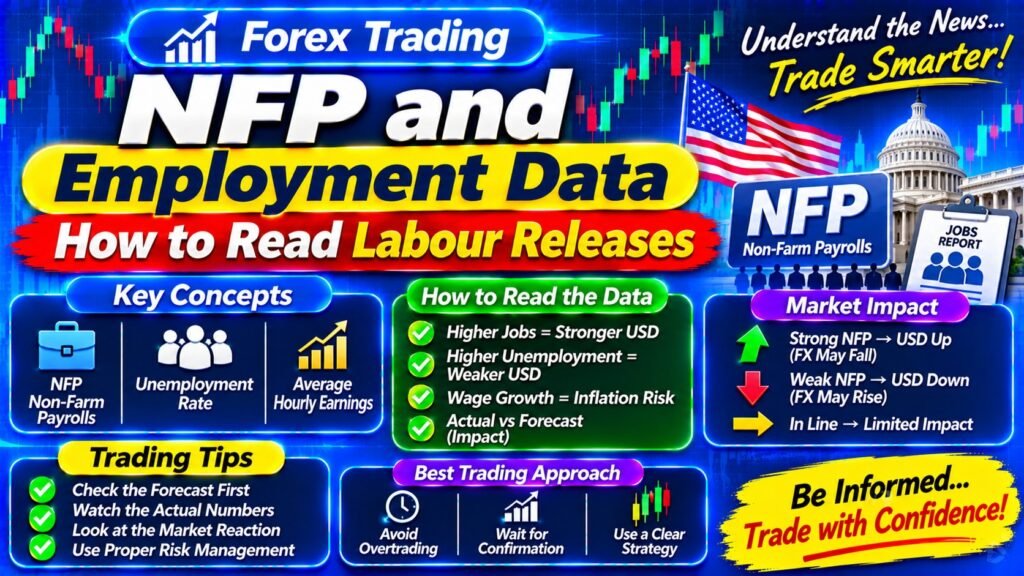
Non-Farm Payrolls produces the most violent regularly scheduled move in forex. It is released monthly, everyone knows exactly when, and it still reprices currencies within seconds. Understanding why employment data carries this weight explains a good deal about how markets think.
Why employment matters
Labour market strength connects to everything central banks care about.
Employed people spend, which supports growth. Tight labour markets push wages up, which feeds inflation. And for the Federal Reserve specifically, maximum employment is half its legal mandate.
So employment data is read as evidence on two questions simultaneously: is the economy healthy, and is inflation pressure building. Both feed into rate expectations.
Non-Farm Payrolls
The headline US employment release, published on the first Friday of each month at 13:30 GMT (12:30 during US daylight saving).
It reports the net change in jobs added or lost, excluding farm workers, government employees in certain categories, and a few other groups. The exclusions exist because agricultural employment is highly seasonal and would distort the trend.
The release contains several figures published simultaneously.
| Figure | Significance |
|---|---|
| Payrolls change | Headline number, most watched |
| Unemployment rate | Percentage seeking work |
| Average hourly earnings | Wage growth — inflation signal |
| Participation rate | Share of population in the workforce |
| Revisions | Corrections to prior months |
Why the headline number is not the whole story
Traders watching only the payrolls figure regularly misread the reaction.
Average hourly earnings frequently matters more. Strong job growth with flat wages suggests expansion without inflation pressure. Weaker job growth with rising wages suggests a tight labour market that may force tightening.
Revisions can dominate. A strong current month alongside a large downward revision to the previous two months tells a different story than the headline suggests, and markets frequently reprice on the revision rather than the new figure.
The unemployment rate can move for unhelpful reasons. It can fall because people found work, or because they stopped looking and left the labour force entirely. The participation rate distinguishes these.
Why the first reaction is often wrong
Algorithms react to the headline payrolls number within milliseconds. Humans then read the wage figure and the revisions, which frequently point the other way. This is why NFP reactions so often spike one direction and reverse within minutes — and why entering during that window is close to a coin flip regardless of your analysis.
Other employment readings
Jobless claims — weekly US filings for unemployment benefits. Higher frequency than NFP and useful as a trend indicator between monthly releases. Individual weeks are noisy; the four-week average is the meaningful figure.
ADP employment — a private payroll estimate published two days before NFP. It is sometimes treated as an NFP preview, though its correlation with the official figure is inconsistent enough that this is unreliable.
JOLTS — job openings data. Slower and less market-moving, but a genuine measure of labour demand watched by policymakers.
Other countries publish equivalents: UK claimant count and average earnings, Australian employment change, Canadian employment change. Each moves its own currency on a similar logic.
How markets interpret the data
The interpretation depends on the current economic context, which catches out traders applying a fixed rule.
During normal expansion: strong employment is currency-positive. Health, growth, possible tightening.
During an inflation fight: strong employment is also currency-positive, but for a different reason — it gives the central bank room to keep rates high without triggering a recession.
During a slowdown: weak employment can be currency-positive if it is read as increasing the chance of stimulus supporting risk assets — though more often it is simply negative.
When a central bank wants cooling: unexpectedly strong employment can be read negatively, as it means policy is not yet working and more tightening is needed. This is one of the few cases where good news genuinely reads as bad.
The consistent principle: markets are not evaluating whether the economy is doing well. They are evaluating what the data means for the rate path.
What NFP day looks like
Knowing the sequence helps you stay out of it.
Before release — spreads widen, liquidity
thins, price often ranges
At release — immediate violent move,
often 50–100+ pips within
seconds on dollar pairs
1–5 minutes — frequent reversal as wages
and revisions are read
15–30 minutes — spreads normalise, genuine
direction becomes clearer
Rest of session— the actual tradeable move
Gold reacts as strongly as dollar pairs, sometimes more. If you trade XAU/USD, NFP is on your calendar whether or not you trade dollar pairs.
The practical approach
Consistent with the news trading lesson, and worth repeating because NFP tempts more traders than any other release.
Know the date. First Friday of the month. Mark it.
Reduce or close beforehand. Positions held through NFP are exposed to slippage that makes your calculated risk inaccurate.
No tight stops in place. Spread widening alone triggers them.
Do not trade the first fifteen minutes. The initial move reverses often enough that entering there is not analysis.
Trade what follows. If NFP genuinely shifts rate expectations, that bias persists for days. That is tradeable at your own pace with normal technical entries.
Beyond the release day
The lasting value of employment data is as trend information.
A single month is noisy — revisions frequently change the picture substantially. What matters is the direction over three to six months: is job growth accelerating or decelerating, are wages rising or flattening.
That trend feeds the rate expectations that drive currency direction over weeks, which is the timeframe where fundamental analysis genuinely helps.
Checking the trend once a month takes five minutes and is considerably more useful than watching the release live.
What to do next
The next lesson covers GDP and growth indicators — slower-moving data that shapes the longer-term picture, and an honest assessment of how much attention it deserves.
Frequently asked questions
What is Non-Farm Payrolls?
The monthly US employment report showing net jobs added or lost, excluding farm and certain government workers. Released on the first Friday of each month, it produces the most violent regularly scheduled move in forex.
Why does NFP move the market so much?
Because employment feeds directly into both halves of the Federal Reserve’s mandate and into inflation through wage pressure. Markets read it as evidence about the future rate path, which is what currency prices reflect.
Which part of the NFP report matters most?
Average hourly earnings often matters more than the headline jobs number, because wage growth signals inflation pressure. Revisions to previous months can also dominate — markets frequently reprice on a revision rather than the current figure.
Why does price reverse shortly after NFP?
Algorithms react to the headline number in milliseconds, then humans read the wage data and revisions, which frequently point the other way. This is why entering during the first minutes is close to a coin flip regardless of analysis quality.
Does NFP affect gold?
Yes, as strongly as dollar pairs and sometimes more. Gold responds to US rate expectations, so any data that shifts the Fed’s likely path moves XAU/USD. NFP belongs on your calendar if you trade gold.
How should I handle NFP as a beginner?
Close or reduce positions beforehand, leave no tight stops in place, avoid trading the first fifteen minutes, and look to trade the directional bias that develops over the following days rather than the release itself.