
Gold and the Dollar — How the Relationship Really Works
October 30, 2026
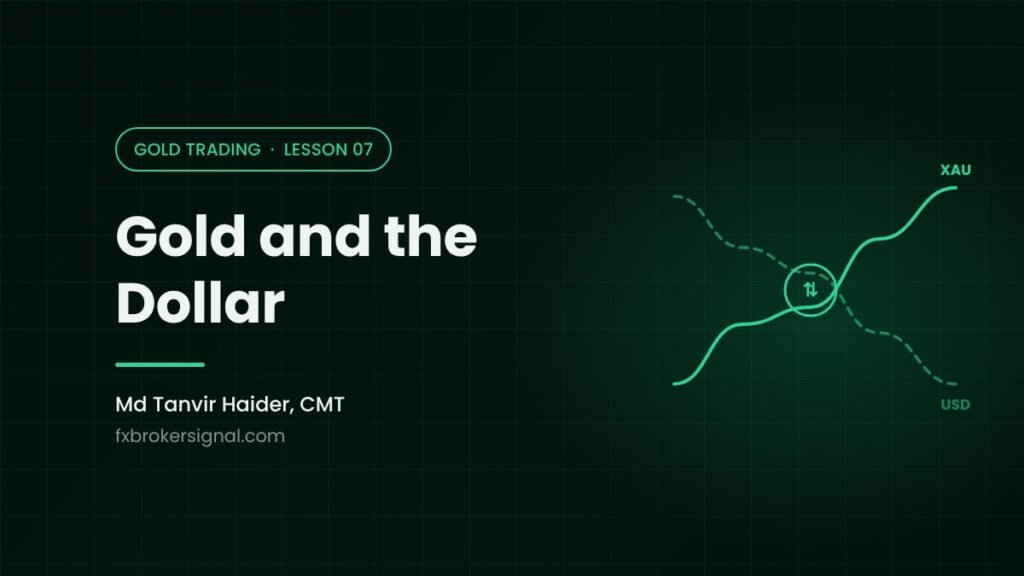
“Gold goes down when the dollar goes up” is the first thing most traders learn about XAU/USD and the first thing that costs them money. The relationship is real, frequently inverse, and reliable enough to be dangerous — because the periods when it breaks are precisely the periods when the largest moves occur.
Why the relationship exists
Two separate mechanisms produce it, and distinguishing them explains when it holds.
The pricing mechanism
Gold is quoted in dollars. When the dollar strengthens against other currencies, gold becomes more expensive for buyers holding those currencies, which dampens demand.
Gold at $2,400/oz
EUR/USD at 1.10 → €2,182 per ounce
Dollar strengthens, EUR/USD to 1.05
Gold still $2,400 → €2,286 per ounce
Same dollar price, 5% more expensive
for a European buyer.
This is arithmetic rather than sentiment, and it operates continuously.
The shared driver
The more important mechanism, and the one traders underweight.
Both gold and the dollar respond to US interest rate expectations. When markets expect tighter Fed policy, the dollar strengthens (higher yields attract capital) and gold weakens (higher real rates make a zero-yield asset less attractive).
What looks like gold reacting to the dollar is frequently both reacting to the same news, independently, at the same moment.
Why this distinction matters practically
If gold simply followed the dollar, watching the Dollar Index would give you a leading indicator. Because both respond to the same underlying driver, the Dollar Index is a correlated instrument rather than a predictor — it tells you what is happening now, not what gold will do next. Traders who treat it as a signal find it works until it does not, which is usually when it matters most.
When the relationship breaks
Three situations, and they are not rare.
Acute risk-off
During serious market stress, capital moves toward both the dollar and gold simultaneously. Institutions need dollars for liquidity and want gold for protection. Both rise together.
This is the most common breakdown and the one that catches traders shorting gold because the dollar is rising.
Central bank accumulation
Sustained official sector buying provides demand that is indifferent to dollar direction. A reserve manager executing a multi-year allocation programme does not pause because the Dollar Index rose.
During periods of heavy accumulation, gold can hold or rise against dollar strength for extended stretches.
Inflation expectations shifting
If inflation expectations rise faster than nominal rates, real rates fall — which supports gold — while the dollar may strengthen on the nominal rate increase.
Gold following real rates rather than the dollar is not the relationship failing. It is the relationship being secondary to the actual driver.
Using the Dollar Index practically
The Dollar Index measures the dollar against a basket of major currencies, weighted heavily toward the euro.
Useful ways to use it:
As context, not signal. A rising index is a headwind for gold longs, not a reason to close them.
As a divergence check. If the dollar is rising and gold is holding, something is supporting gold independently — worth knowing before you fade a gold move.
As a confirmation filter. A gold long with the dollar also falling has two things working for it rather than one.
Unhelpful ways:
As a trigger. Entering gold because the index turned is trading a correlated instrument rather than the one in front of you.
As a substitute for gold’s own structure. The level on the gold chart determines your entry and stop, not the index.
Watching the right thing instead
If the dollar is a correlated instrument rather than a driver, what should a gold trader actually follow?
US rate expectations. Where the market thinks the Fed is heading. This drives both gold and the dollar, so following it directly is more informative than following one of its effects.
Real yields. Inflation-protected government bond yields are the cleanest available proxy for the real rate that determines gold’s opportunity cost.
The US economic calendar. CPI, NFP and Fed decisions shift rate expectations, which is why they move gold so violently.
Risk sentiment. Equities and the VIX, which indicate whether the safe-haven channel is active.
A gold trader tracking rate expectations and risk sentiment has the two variables that matter. Adding the Dollar Index to that is optional.
Correlation is not constant
An important technical point about correlations generally.
The inverse relationship between gold and the dollar varies in strength considerably over time. It can be strongly inverse for months, then weak or briefly positive for weeks.
This means any strategy built on the correlation holding will work for a period and then fail. The failure is not a malfunction — it is the correlation doing what correlations do.
The practical conclusion: use the relationship as one input among several, never as the basis for a position.
The correlated exposure trap
Worth flagging because it affects risk directly.
A trader long gold and short EUR/USD believes they hold two positions. In practice, if the dollar is driving both, they hold two expressions of one bet on dollar direction.
Long gold = short dollar exposure
Short EUR/USD = long dollar exposure
These partially offset — the trader
may have less exposure than intended.
Long gold + long EUR/USD
= double short dollar exposure
= 2% risk, not 1% twice
Before opening a gold position, check what dollar exposure you already carry. Positions that feel diversified frequently are not — this is the same correlation trap covered in the Fundamental Analysis section, and gold is one of the most common ways traders fall into it without noticing.
A practical approach
Know the rate environment. Tightening, easing, or holding. This drives gold more than the dollar does.
Glance at the Dollar Index for context before entering, not for the entry itself.
Check for divergence. Gold holding against dollar strength tells you something.
Count your dollar exposure across all open positions before adding gold.
Do not short gold purely on dollar strength. During risk-off both rise, and that is when the move is largest.
What to do next
The next lesson covers news and gold — which releases move it, how it behaves around them, and the practical handling of high-impact events on this instrument.
Frequently asked questions
Why does gold fall when the dollar rises?
Two mechanisms. Gold is priced in dollars, so dollar strength makes it more expensive for non-dollar buyers. More importantly, both respond to US rate expectations — tighter policy strengthens the dollar and pressures gold independently.
Is the gold-dollar relationship reliable?
Frequently inverse but not dependable. It breaks during acute risk-off when both are bought as havens, during heavy central bank gold accumulation, and when real rates move differently from nominal rates.
Can I use the Dollar Index to predict gold?
Not as a predictor. Because both respond to the same underlying driver, the index is a correlated instrument rather than a leading one. It works as context and as a divergence check, not as a trigger.
What should a gold trader watch instead of the dollar?
US rate expectations and real yields, since these drive both gold and the dollar. Adding the US economic calendar and a risk sentiment check covers the variables that actually matter.
Can gold and the dollar rise together?
Yes, and it happens during serious market stress when institutions need dollars for liquidity while also wanting gold for protection. This is the most common breakdown and catches traders shorting gold on dollar strength.
How does gold affect my overall dollar exposure?
A long gold position is effectively short dollar exposure. Combined with a long EUR/USD position, you hold double the dollar exposure you may think — two positions that behave as one larger bet.