
How to Choose a Trading Strategy and Build a Plan
October 31, 2026

You now have eight approaches to choose from, which creates a new problem: choosing badly. Most traders select a style based on what sounds appealing rather than what their schedule and temperament can actually sustain — and then conclude the strategy failed when the mismatch surfaces.
Start with your schedule, not your preference
This is the filter that eliminates most options immediately, and applying it first saves months.
| Available time | Viable styles |
|---|---|
| 3+ hrs during London/overlap | Any, including scalping |
| 2 hrs during an active session | Intraday, breakout |
| 30 min daily, any time | Swing, trend following |
| Weekends only | Position trading, or analysis only |
Note what is missing from the third row: scalping and intraday. If your available time does not coincide with London or the overlap, those styles are not options regardless of how much they appeal.
A trader with thirty evening minutes who selects intraday trading has chosen a method they cannot execute. Every subsequent problem traces back to that decision.
Then match temperament
Schedule narrows the field. Temperament decides between what remains.
If you need to be right often — range trading and trend following suit you. Win rates of 50–65% are sustainable psychologically. Breakout trading, at 35%, will feel like constant failure and you will abandon it during an ordinary drawdown.
If you can tolerate frequent small losses — breakout trading becomes available, and it has genuine advantages: mechanical rules, clear invalidation, large winners.
If waiting is difficult — swing trading will be painful. Positions sitting for days while moving against you is the core experience of the style.
If rapid decisions stress you — avoid scalping entirely. It is the most demanding style under time pressure.
The question worth answering honestly
Not “which strategy is most profitable” — they can all be profitable. The question is which one you will still be following in six months, after a losing streak, when following it feels wrong. A mediocre strategy executed consistently beats an excellent one abandoned in month three, and the second scenario is far more common.
The five-step selection process
1. Eliminate by schedule. Cross out styles you cannot execute during your available hours.
2. Eliminate by temperament. Cross out those whose win rate profile or holding period you know you will struggle with.
3. Pick one from what remains. One. Not a combination.
4. Write it out completely. The five questions from the first lesson: what, when, stop, target, size.
5. Trade it for fifty trades without modification.
Step five is the one traders skip, and skipping it makes the whole process meaningless. Fifty trades is the minimum sample where results start reflecting the method rather than variance.
Building the written plan
A complete trading plan on one page. Specific enough that someone else could follow it.
STYLE: Swing trading
INSTRUMENTS: EUR/USD, GBP/USD, XAU/USD
TIMEFRAMES: Daily direction, 4H entry
SESSIONS: Review after daily close
ENTRY CONDITIONS — all must be true
Daily close above 200 EMA (long)
Daily ADX above 25
4H pullback to 50 EMA or daily support
Rejection candle at the level
RSI 40–55 turning up
EXIT
Stop: 2 × daily ATR below the level
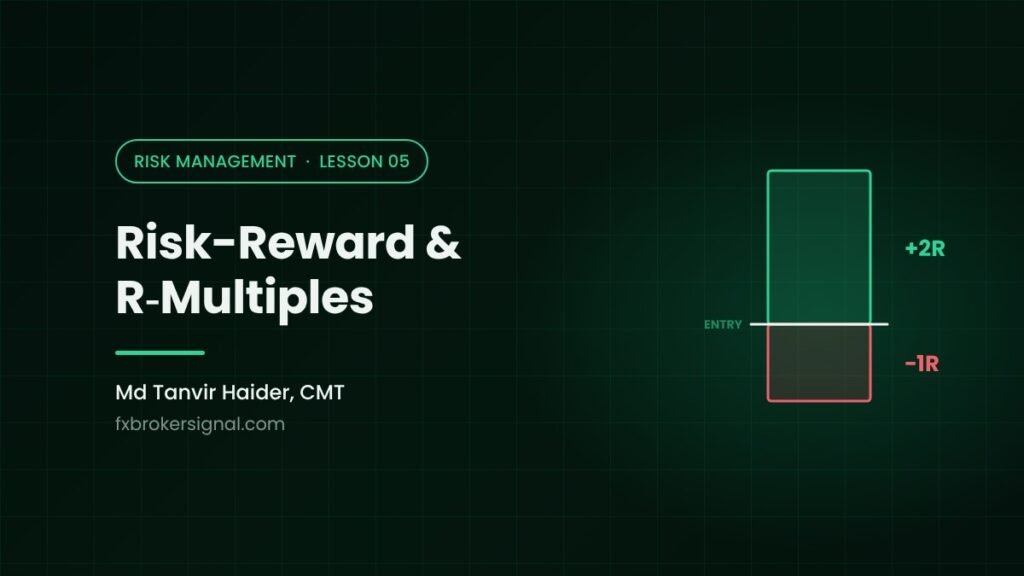
Target: 2.5 × stop distance
One stop, one target, full close
RISK
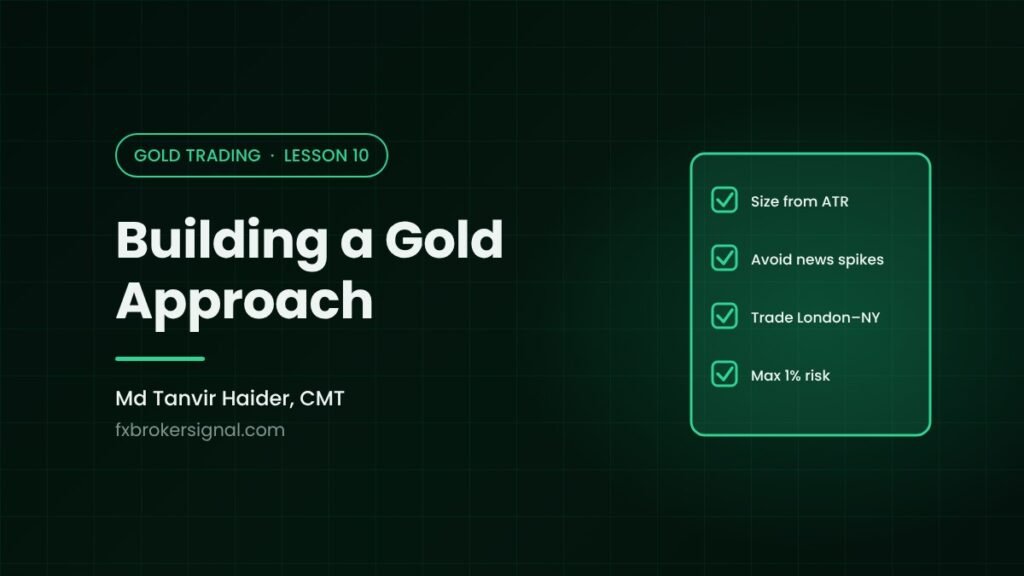
1% per trade, always
Maximum 3 open positions
Correlated pairs count as one
Stop trading at −6% in a month
ROUTINE
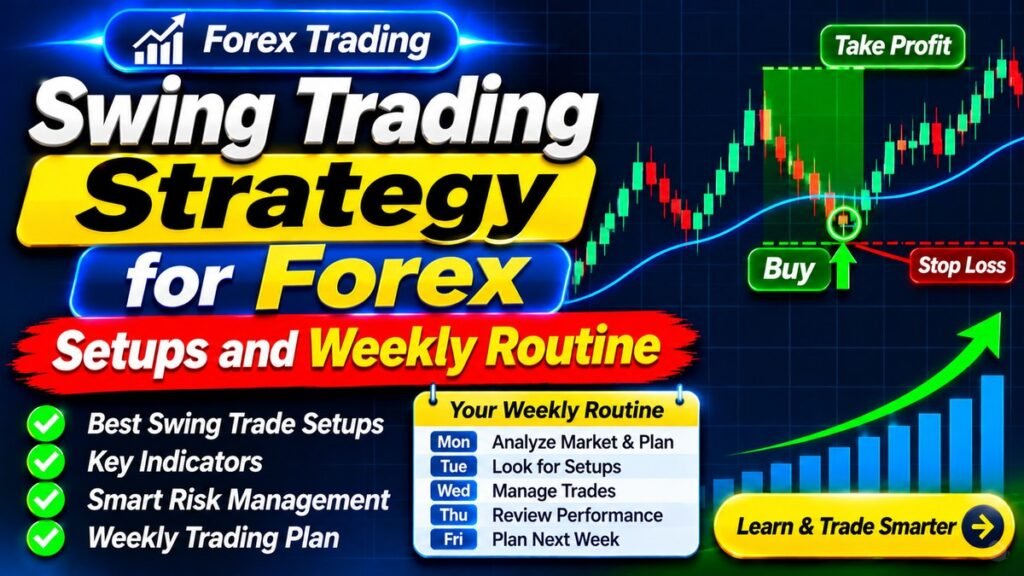
Sunday: mark levels, check calendar
Daily: 20 min after close
Saturday: journal review
Print it. Keep it visible. The value is not in having written it — it is in being able to check, before any trade, whether the conditions are actually met.
The review cycle
After fifty trades, assess honestly. Four questions, in order.
Did I follow the plan? This comes first, and the answer is usually “mostly.” Identify the trades taken outside the criteria and examine them separately — they often account for a disproportionate share of losses.
What is the expectancy? Win rate and average win-to-loss, combined into one number as covered in Lesson 1.
Where do the losses cluster? One instrument, one session, one setup type, one time of week. Patterns invisible day-to-day become obvious across fifty trades.
What single change would help most? One. Change it, and run another fifty trades.
Changing three things at once means learning nothing, because no result can be attributed to any specific adjustment.
When to change strategy
Rarely, and not for the reasons most traders do.
Valid reasons: your schedule changed and the style no longer fits; expectancy is negative across a hundred-plus trades with the plan genuinely followed; the style conflicts with your temperament in a way that makes consistent execution impossible.
Invalid reasons: five consecutive losses; a flat month; someone described a better-sounding method; boredom.
The strategy-hopping cycle is the most reliable way to lose money slowly. Each new method gets abandoned during its first drawdown, which means the trader experiences every strategy’s losing periods and none of their winning ones.
What actually determines results
Having written eleven lessons on strategy, the honest summary is that strategy selection matters less than the things surrounding it.
Position sizing. A good strategy at 5% risk fails. A mediocre one at 1% survives.
Consistency. Following the rules on the trade that looks marginal, and on the day after three losses.
Patience. Waiting for setups, and waiting through drawdowns.
Record keeping. Without a journal, you cannot identify what to improve.
These four have more influence on outcomes than the choice between trend following and range trading. In twelve years I have never seen a trader fail because they picked the wrong strategy from a list of reasonable ones. I have seen many fail on position sizing and consistency, repeatedly, across several strategies.
On using signals
A note, since many readers follow signal channels including ours.
A signal is someone else’s analysis. It replaces the entry decision and nothing else. Position sizing, whether the trade fits your plan, and how you respond to a losing streak all remain yours — and those are the parts that determine your results.
The traders who use signals well treat them as a supplement to a method they understand. Those who treat signals as a substitute for having a method tend to struggle in exactly the same ways they would have struggled trading alone.
Our own signals use a single entry, one stop and one target with a full close, deliberately — that structure makes the position sizing arithmetic straightforward and removes mid-trade decisions. But the sizing itself is still yours to calculate, and no provider can do that part for you.
What to do next
You have completed the Trading Strategies section. The remaining Academy sections cover technical analysis, risk management, trading psychology and MT4/MT5 mechanics in the same detail.
Before moving on, one suggestion: complete the written plan above for whichever style you selected, and trade it on demo for fifty trades. That will teach you more than the next section read immediately.
Frequently asked questions
Which trading strategy is best for beginners?
Swing trading or trend following, for most people. Both forgive imprecise entries, require limited screen time, and have win rates that are psychologically sustainable. Scalping is the most commonly chosen and the least suitable.
How do I choose a trading strategy?
Eliminate by schedule first — styles you cannot execute during your available hours are not options. Then eliminate by temperament, considering win rate profile and holding period. Pick one from what remains and trade it for fifty trades without changes.
Can I use more than one strategy?
Eventually, but not while learning. Running two methods simultaneously means neither accumulates enough trades to assess, and it becomes easy to switch between them based on which recently worked — which is not a system.
When should I change my trading strategy?
When your schedule changes, when expectancy is negative across a hundred or more trades with the plan genuinely followed, or when the style conflicts with your temperament. Not after five losses, a flat month, or hearing about something better.
Do I need a written trading plan?
Yes. Without written rules, criteria loosen on days when you want to trade, and results cannot be assessed because the input was never consistent. A plan specific enough that another person could follow it is the working standard.
Does the strategy matter less than risk management?
Considerably less. A sound strategy at 5% risk per trade fails; a mediocre one at 1% survives long enough to improve. Position sizing, consistency, patience and record keeping influence outcomes more than the choice between reasonable strategies.